Spine-leaf architecture What is spine-leaf architecture?
A spine-leaf architecture is data center network topology that consists of two switching layers—a spine and leaf. The leaf layer consists of access switches that aggregate traffic from servers and connect directly into the spine or network core. Spine switches interconnect all leaf switches in a full-mesh topology.
Table of Contents
Time to read: 3 minutes 45 seconds | Published: March 27, 2026
What are the components of spine leaf architecture?
Spine leaf architecture consists of two main layers: the Spine layer and the Leaf layer. Leaf switches aggregate traffic from servers and storage, connecting directly into the network core. On the other hand, spine switches act as the high-speed backbone, interconnecting all leaf switches in a full-mesh topology to ensure any-to-any connectivity with minimal latency.
How does a spine-leaf architecture differ from traditional network designs?
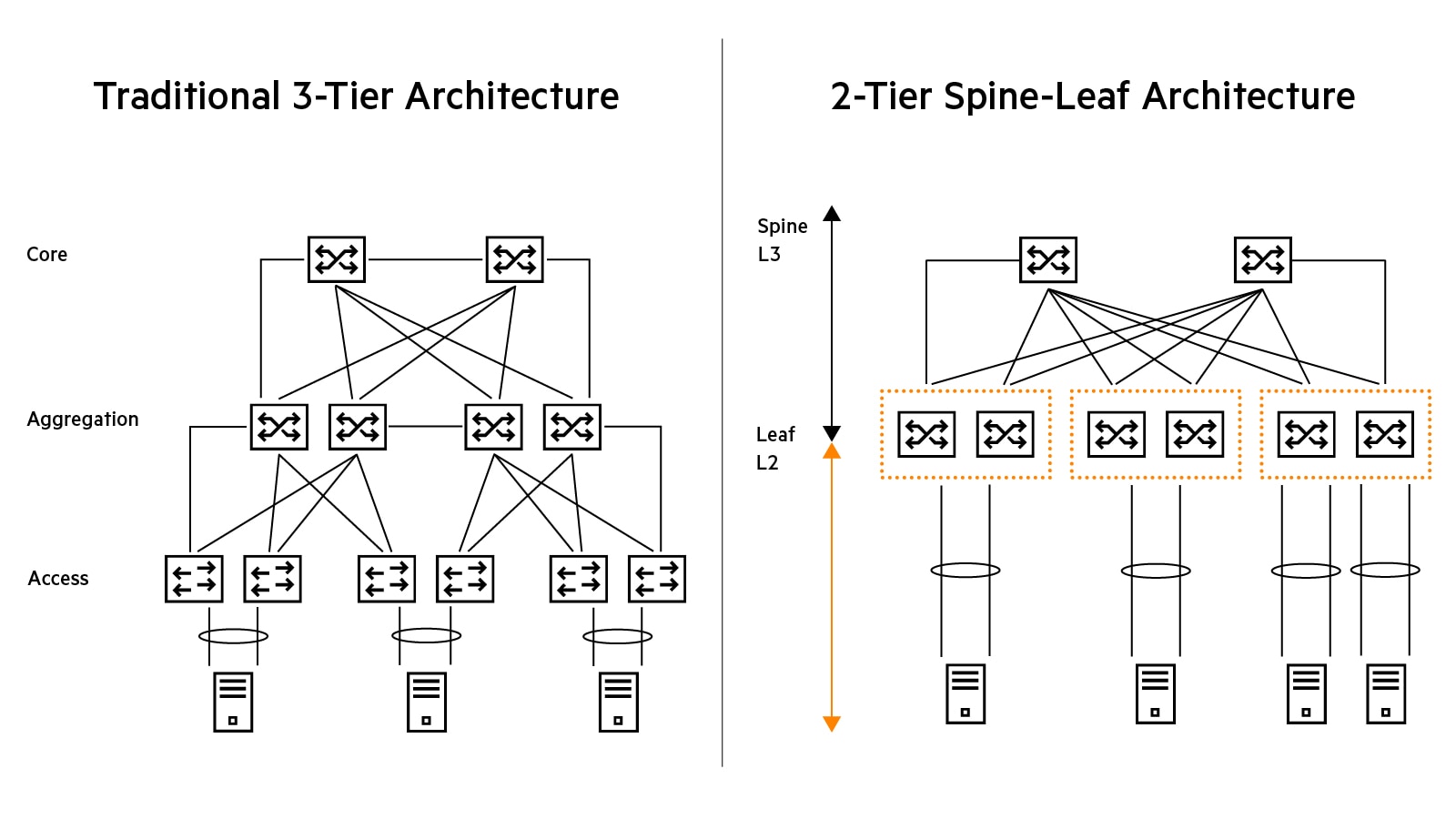
Traditionally, data center networks were based on a three-tier model:
- Access switches connect to servers.
- Aggregation or distribution switches provide redundant connections to access switches.
- Core switches provide fast transport between aggregation switches, typically connected in a redundant pair for high availability.
At the most basic level, a spine-leaf architecture collapses one of these tiers, as depicted in these diagrams.
Other common differences in spine-leaf topologies include:
- The removal of Spanning Tree Protocol (STP).
- Increased use of fixed port switches over modular models for the network backbone.
- More cabling to purchase and manage, given the higher interconnection count.
- A scale-out vs. scale-up of infrastructure.
Why are spine-leaf architectures becoming more popular?
Given the prevalence of cloud and containerized infrastructure in modern data centers, east-west traffic continues to increase. East-west traffic moves laterally, from server to server. This shift is primarily explained by modern applications having components that are distributed across more servers or VMs.
With east-west traffic, having low-latency, optimized traffic flows is imperative for performance, especially for time-sensitive or data-intensive applications. A spine-leaf architecture aids this by ensuring traffic is always the same number of hops from its next destination, so latency is lower and predictable.
Capacity also improves because STP is no longer required. While STP enables redundant paths between two switches, only one can be active at any time. As a result, paths often become oversubscribed. Conversely, spine-leaf architectures rely on protocols such as Equal-Cost Multipath (ECMP) routing to load balance traffic across all available paths while still preventing network loops.
In addition to higher performance, spine-leaf topologies provide better scalability. Additional spine switches can be added and connected to every leaf, increasing capacity. Likewise, new leaf switches can be seamlessly inserted when port density becomes a problem. In either case, this "scale-out" of infrastructure doesn't require any re-architecting of the network, and there is no downtime.
What are the benefits of spine leaf architecture?
Spine leaf architecture offers superior scalability and lower latency compared to legacy 3-tier designs. By keeping all network paths active via ECMP, it provides massive bandwidth for server-to-server traffic. Unlike traditional models that require complex re-architecting to grow, this design allows for "scale-out" expansion, where adding switches increases capacity without network downtime.
Building a spine-leaf architecture with HPE Aruba Networking CX Switching
The HPE Aruba Networking CX Switching Portfolio is designed for the evolving, complex demands of modern data center environments, including spine-leaf fabrics. HPE Aruba Networking CX switches are based on a distributed, non-blocking architecture that delivers true wired speed performance from 1GbE to 100GbE.
HPE Aruba Networking CX switches for spine-leaf fabrics include:
- HPE Aruba Networking CX 6400: A modular 5- or 10-slot switch with up to 28Tbps capacity
- HPE Aruba Networking CX 8325: A 1U switch with 1/10/25/40/100GbE connectivity ideal for leaf or spine switches
- HPE Aruba Networking CX 8320: A 1U leaf switch with 10GbE server connectivity and 40GbE to the spine
- HPE Aruba Networking CX 8400: A modular switch with up to 19.2Tbps capacity, ideal for spine and leaf switches where higher port density is needed
All HPE Aruba Networking CX switches are powered by AOS-CX, a cloud-native operating system that simplifies the management of data center networks with powerful automation, analytics, and support for live upgrades.
Spine-leaf architecture FAQs
How does spine leaf architecture work?
Spine-leaf is a flat, two-tier topology designed for high-performance East-West data. Every leaf switch connects to every spine switch, ensuring data always crosses exactly two "hops". By replacing the restrictive Spanning Tree Protocol (STP) with Layer 3 routing and ECMP, it utilizes all available paths simultaneously to prevent bottlenecks common in 3-tier models.
What are the use cases for spine leaf architecture?
Spine leaf architecture is the standard for modern data centers handling high volumes of lateral traffic. Key use cases include cloud computing, containerized microservices, and AI/ML workloads. It is also essential for big data analytics and high-frequency trading, where predictable performance and high-speed data transfer between distributed nodes are mission-critical.
What are the challenges of implementing spine leaf architecture?
The primary challenges involve increased cabling complexity and the need for advanced routing expertise. Because every leaf must connect to every spine, physical cable management is more intensive than in 3-tier models. Additionally, configuring the Layer 3 protocols and overlays required for a non-blocking fabric requires more sophisticated management tools and planning.
What is the difference between spine leaf architecture vs. Clos architecture?
Spine-leaf is a modern, two-stage application of the Clos architecture, a multi-stage network topology designed for non-blocking performance. While Clos architecture is the theoretical framework used to ensure any input can connect to any output without interference, spine-leaf is the specific implementation used to replace traditional hierarchies in high-density data centers.
How does spine-leaf improve data center scalability?
Spine-leaf architecture enables "horizontal" scaling. If you need more server ports, you add a leaf switch; if you need more inter-switch bandwidth, you add a spine switch. This "pay-as-you-grow" approach allows for expansion without replacing existing hardware or changing the network's logical structure, making it far more flexible than traditional "vertical" scale-up models.