Hybrid cloud storage What is Hybrid cloud storage?
Hybrid cloud storage combines on-premises (data center or colocation) and public cloud storage resources within an organization’s data landscape via technology that enables data portability. A hybrid cloud strategy enables organizations to leverage on-premises storage and public cloud storage to achieve unprecedented agility, flexibility, and resource optimization across environments.
Hybrid cloud storage (a subset of the cloud storage category) is a model where data can be stored in a remote, network-accessible system maintained by a service provider, and accessed via the internet or dedicated connectivity. Hybrid cloud storage blends this approach with local, on-premises infrastructure, providing the scalability and elasticity of cloud storage along with the control, performance, and security benefits of on-premises systems.
Time to read: 6 minutes 40 seconds | Updated: April 23, 2026
Table of Contents
Hybrid cloud storage highlights
- Combines on-prem and cloud storage enabling organizations to leverage the strengths of both environments.
- Explains capabilities for data replication and backup across on-prem and cloud locations to support business continuity.
- Provides unified management tools to administer on-prem and cloud storage resources seamlessly.
What is hybrid cloud storage architecture?
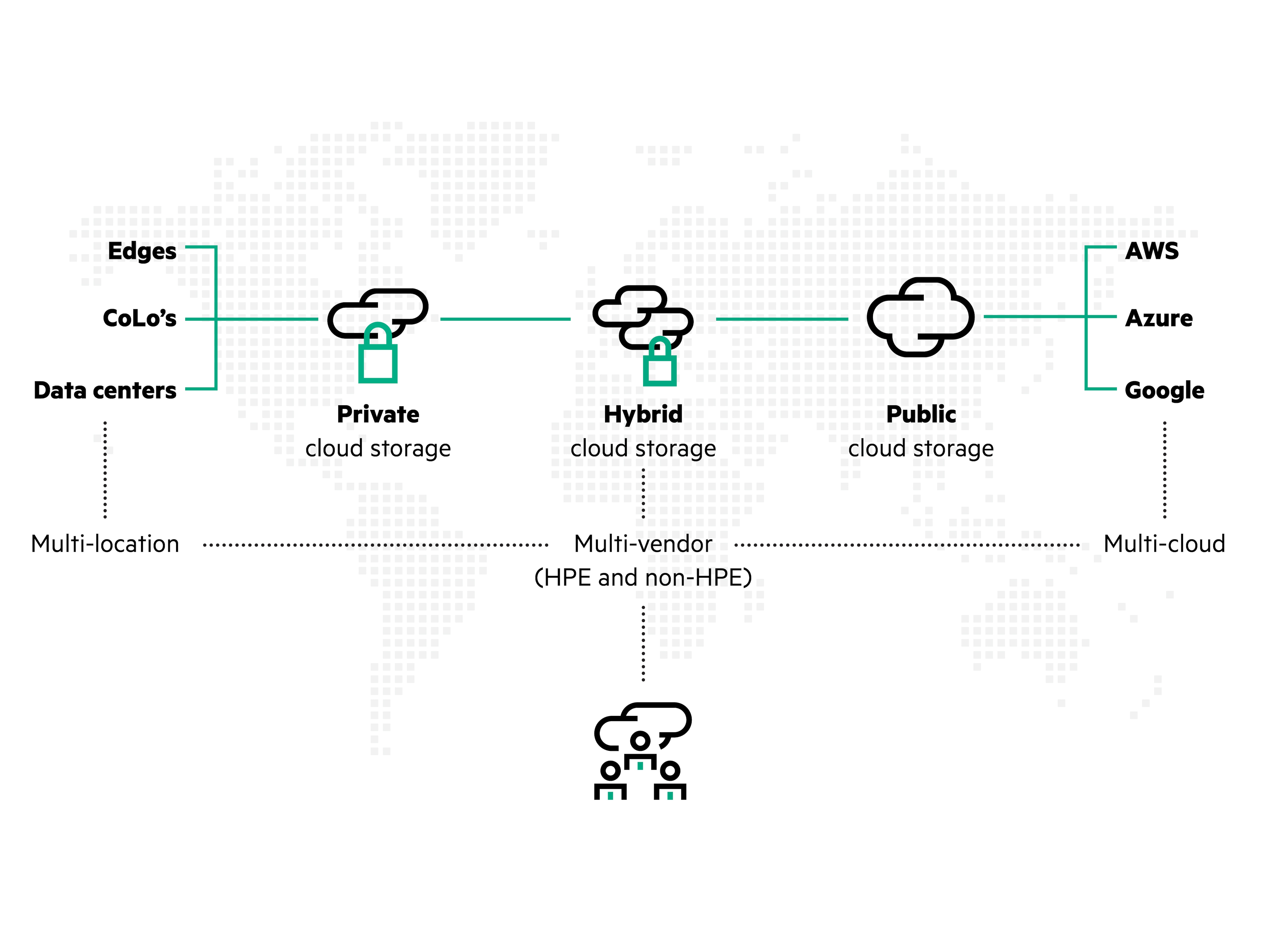
Hybrid cloud storage employs on-premises and public cloud storage resources to provide a flexible and scalable storage solution. A hybrid cloud strategy enables organizations to leverage on-premises storage and public cloud storage with seamless migration between the two to achieve unprecedented agility and flexibility across environments.
Hybrid cloud storage is comprised of:
- On-premises storage: The most advanced on-prem storage offerings provide a cloud experience in terms of provisioning workloads and ease of management. Organizations use on-premises storage for sensitive or essential data that needs high performance, low latency, or regulatory compliance.
- Public cloud storage: Cloud service providers such as AWS, Azure, and GCP offer storage capabilities for public cloud storage. Public cloud storage solutions are scalable and offer low cost of entry, typically with pay-as-you-go pricing. These solutions can work well for backup, archive, test/dev, and new initiatives. Hybrid cloud combines on-premises infrastructure and public cloud services. Organizations operate hybrid cloud storage to improve flexibility, performance, and cost by effortlessly migrating data between on-premises and public cloud resources based on changing IT demands.
What are the different types of hybrid cloud storage?
Across hybrid cloud, storage resources may leverage a variety of storage data types to support diverse use cases:
- Block storage: Ideal for applications that require high performance and low latency, such as databases.
- File storage: NFS and SMB-accessible shared file systems are appropriate for programs like document collaboration and content management systems that need access to shared files.
- Object storage: A highly scalable and durable storage solution, object storage saves data as metadata-rich objects for unstructured data, backups, and archives.
How to manage data efficiently in hybrid cloud storage?
Efficient data management is paramount in hybrid cloud storage environments to enhance performance, cost-effectiveness, and data accessibility. Leading storage vendors today offer visibility and control across hybrid environments, including options for data replication and backup, archive, and disaster recovery.
Effective data management in hybrid cloud storage involves optimizing data storage through data efficiency, automation, and data provisioning.
Advantages and disadvantages of hybrid cloud storage
Advantages
- Speed up business outcomes: By using hybrid cloud storage, users don’t have to wait to requisition and procure additional on-premises capacity. Once data is replicated in the cloud, lines of businesses and developers can start running queries within minutes.
- Increase visibility: Most providers offer a central data management console that allows users to view usage and spend, as well as detailed insights into capacity trends.
- Cost savings: With hybrid cloud storage, users can store data in the most cost‑effective way on a per‑application basis, avoiding the need to purchase and provision additional on‑premises storage infrastructure. This ability enables financial clarity with variable monthly payments based on actual usage.
- Scale on demand: Using hybrid cloud storage, users can access additional capacity in minutes, not months, which allows users to limit the risks of over-provisioning and under-provisioning.
- Free up IT resources: In a hybrid cloud storage model, routine tasks can be managed by the service provider, which allows IT to focus on strategic business initiatives instead.
Disadvantages
- Increased complexity: With two or more storage locations, at least two sets of IT infrastructure must be managed with software designed to handle the multiple locations.
- Higher latency: With data moving to and from the cloud, communication speeds are slower than between infrastructure components in one location.
- Increased management: Hybrid cloud storage comes with the need to manage multiple supplier contracts and system management tools.
What are the use cases of hybrid cloud storage?
Organizations use hybrid cloud storage to enable agility and scalability and to modernize and optimize resource utilization by gaining the ability to place apps and data based on performance, cost, and other requirements. Typical use cases include:
- Business continuity and disaster recovery: Hybrid cloud storage can be used when organizations want to keep core data on-premises but allow the business to continue operating during a system failure. By replicating the data in the cloud, enterprises essentially switch workloads to the cloud while repairing or recovering production systems.
- Remote workplaces: Organizations deploy hybrid cloud storage to allow remote access to data while maintaining workload productivity and efficiency.
- Website efficiency: Object stores in a hybrid cloud setup can be used for primary data that customer-facing websites access directly from the cloud. This saves on storage hardware and improves site performance.
- Faster data retrieval: Users often separate archives from frequently used data and place the dormant data in the cloud. This speeds retrieval times for accessing the primary data.
- Security and regulatory compliance: Organizations with regulatory compliance issues often use a private cloud to store sensitive data, while using on-premises hardware or public cloud to store VMs and applications.
What are the best practices of hybrid cloud storage?
- Strategic planning: Conduct a thorough assessment of data requirements and develop a comprehensive hybrid cloud storage strategy aligned with business goals, SLAs, compliance needs, and budget constraints.
- Security and compliance measures: Implement robust security protocols, including encryption, access controls, and identity management to safeguard data both in transit and at rest. Ensure compliance with relevant regulations and industry standards.
- Efficient data management: Classify data based on importance and access frequency, implementing tiered storage architectures for optimal resource utilization. Utilize tools and platforms for seamless data migration, integration, and centralized management across on-premises and cloud environments.
- Performance optimization: Strategically place data on the most suitable storage based on access patterns, latency requirements, and cost considerations. Employ optimization techniques such as caching, data compression, and deduplication to enhance overall system performance.
Cost-effective operations: Monitor storage usage and costs, implementing strategies like cost allocation, budgeting, and regular testing for optimization. Consider factors like data egress fees, storage tiering, and cloud provider pricing models to control expenses and maximize return on investment. Continuous refinement ensures scalability, reliability, and cost-effectiveness in an evolving hybrid cloud storage environment.
How does HPE lead hybrid cloud storage innovation?
Hewlett Packard Enterprise (HPE) is at the forefront of hybrid cloud storage innovation, offering a comprehensive suite of products and solutions tailored to meet businesses' evolving needs. Whether you need private cloud storage that operates like a public cloud, or hybrid data mobility, HPE has you covered. Additionally, we offer management with advanced intelligence and automation capabilities that unifies experiences across hybrid clouds. With a focus on flexibility, scalability, and efficiency, HPE empowers organizations to seamlessly leverage the benefits of both on-premises and cloud-based storage environments.
HPE Alletra Storage MP is a multi-protocol enterprise storage platform that unifies block, file and object workloads at scale on a single cloud-managed disaggregated architecture. It delivers one AI-driven cloud experience across hybrid cloud environments, simplifying storage management and enabling flexible deployment options.
HPE Alletra Storage MP B10000 is built on the HPE Alletra Storage MP architecture, the HPE Alletra Storage MP B10000 enables you to modernize your enterprise block and file storage. AI-driven cloud management, disaggregated scaling, and 100% data availability make this an ideal solution for your mission-critical applications.
HPE Alletra Storage MP X10000 is built on the HPE Alletra Storage MP architecture – helps you unleash the power of your unstructured data with data intelligence, enterprise performance at scale, and simple to manage object storage to drive innovation and accelerate time to value.
GreenLake is the delivery model for HPE Alletra Storage MP. GreenLake brings the cloud experience to all your IT—now with built-in intelligence that makes it smarter every day. HPE Alletra Storage MP customers can manage all their storage and data management across hybrid cloud environments with a common experience, from a common UI.
HPE Alletra Block Storage for AWS and HPE Alletra Block Storage for Azure are software‑defined storage solutions managed through GreenLake that bring HPE Alletra Storage MP B10000 capabilities to AWS and Azure public cloud offerings. This solution makes it possible to experience the same enterprise‑class storage data services between on‑premises and public cloud while also benefiting from unified management across hybrid cloud.
HPE Private Cloud PC3000: Build a self-service, self-managed private cloud on demand, wherever you need it, to simplify VM to infrastructure management.
HPE StoreOnce backup appliances: Provide high-performance, deduplicated backup and recovery solutions to protect data efficiently while minimizing storage costs.
With its comprehensive portfolio of hybrid cloud storage solutions, HPE continues to lead the way in empowering organizations to unlock the full potential of their data assets while driving innovation and agility in the digital era.
Hybrid cloud storage FAQs
How is hybrid cloud storage different from multi-cloud storage?
Hybrid cloud blends on-premises storage with one or more clouds, whereas multi-cloud uses two or more cloud providers without necessarily integrating on-prem systems. Hybrid cloud emphasizes seamless movement of data between local and cloud tiers, while multi-cloud emphasizes avoiding vendor lock-in.
Why do organizations adopt hybrid cloud storage?
Top drivers include scalability for burst workloads, cost optimization via tiering cold data to cloud, and data sovereignty and compliance requirements. Business continuity is a major factor, with hybrid cloud storage offering cloud-based disaster recovery. It also provides flexibility to modernize without abandoning existing infrastructure.
How do I secure hybrid cloud storage?
Security best practices include end-to-end encryption (in transit and at rest), as well as role-based access controls and identity federation. It’s important to adopt immutable backups or WORM (write-once, read-many) policies, as well as maintaining unified monitoring and anomaly detection across on-prem and cloud tiers.
How is data moved between on-prem and cloud in a hybrid model?
Data mobility is typically achieved through several means, including storage gateways and APIs, policy-based tiering and lifecycle management, snapshots or replication for DR, and native cloud connectors built into enterprise arrays.
What performance considerations matter in hybrid cloud storage?
Key factors include latency between sites, throughput for large dataset movement, local caching for frequently accessed data, and intelligent tiering to ensure workloads aren’t slowed down when data moves to cloud.
How does hybrid cloud storage support AI and analytics?
Hybrid cloud lets organizations train on local high-performance storage, burst to cloud for additional GPU/compute resources. It enables cost-effective storage massive historical datasets in cloud archives and can share curated datasets across geographies securely.
How do I choose the right hybrid cloud storage solution?
When choosing a hybrid cloud storage solution, evaluate based on cloud integration options, unified management capabilities, security/compliance features, cost transparency, and support for automation, APIs, and data services (replication, snapshots, tiering).
How does hybrid cloud storage help control costs?
Hybrid cloud storage can reduce CapEx by shifting cold or infrequently accessed data to lower-cost cloud tiers, while keeping hot data local to minimize cloud egress charges. Automated lifecycle policies optimize data placement and prevent runaway cloud bills.
Can hybrid cloud storage prevent vendor lock-in?
Yes. By supporting open protocols (NFS, SMB, S3) and offering data mobility across different clouds, hybrid storage platforms give enterprises flexibility to shift or replicate data without being tied to a single provider.
Is hybrid cloud storage suitable for compliance-sensitive industries?
Yes—healthcare, finance, and government agencies use hybrid models to keep regulated data on-prem while leveraging cloud for scale. Proper governance, encryption, and audit controls are essential.
What are the cost models for hybrid cloud storage?
Models include pay-as-you-go for cloud tiers, subscription/consumption-based services (like GreenLake), and blended TCO models where CapEx on-premises is complemented by OpEx in the cloud.