Introduction to DVS
Describes how Cray Data Virtualization Service (DVS) is essential for distributing images and configuration data in the new Cray management system.
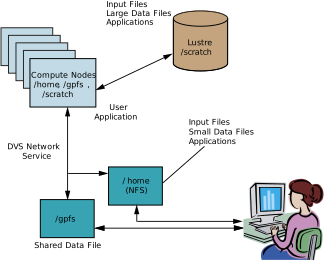
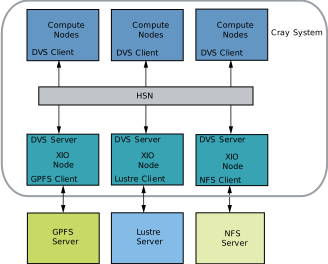
Cray Data Virtualization Service (DVS) is a distributed network service that projects local file systems resident on I/O nodes or remote file servers to compute and service nodes within the Cray system.
Projecting is simply the process of making a file system available on nodes where it does not physically reside. DVS-specific configuration settings enable clients (compute nodes) to access a file system projected by DVS servers. Thus, Cray DVS, while not a file system, represents a software layer that provides scalable transport for file system services. See the mount(8) and dvs(5) man pages for more information.
DVS Use Cases
DVS plays an essential role in the new Cray management system (CMS) paradigm.- DVS is tightly coupled with the Simple Shares service.
- During system boot, Netroot is mounted as a DVS mount.
- DVS is used by the
cray_image_bindingservice to distribute the Cray programming environment (PE) to compute and login nodes.
basic rather than required.
cray_dvs service configuration parameters enable system administrators to provide their users with client mounts that can be tuned for high performance in a variety of use cases. When projecting external file systems, DVS provides I/O performance and scalability to a large number of nodes, far beyond the typical number of clients supported by a single NFS server. Operating system noise and impact on compute node memory resources are both minimized in the Cray DVS configuration. Cray DVS uses the Linux-supplied virtual file system (VFS) interface to process file system access operations. This allows DVS to project any POSIX-compliant file system. Cray has extensively tested DVS with NFS and General Parallel File System (now Spectrum Scale).